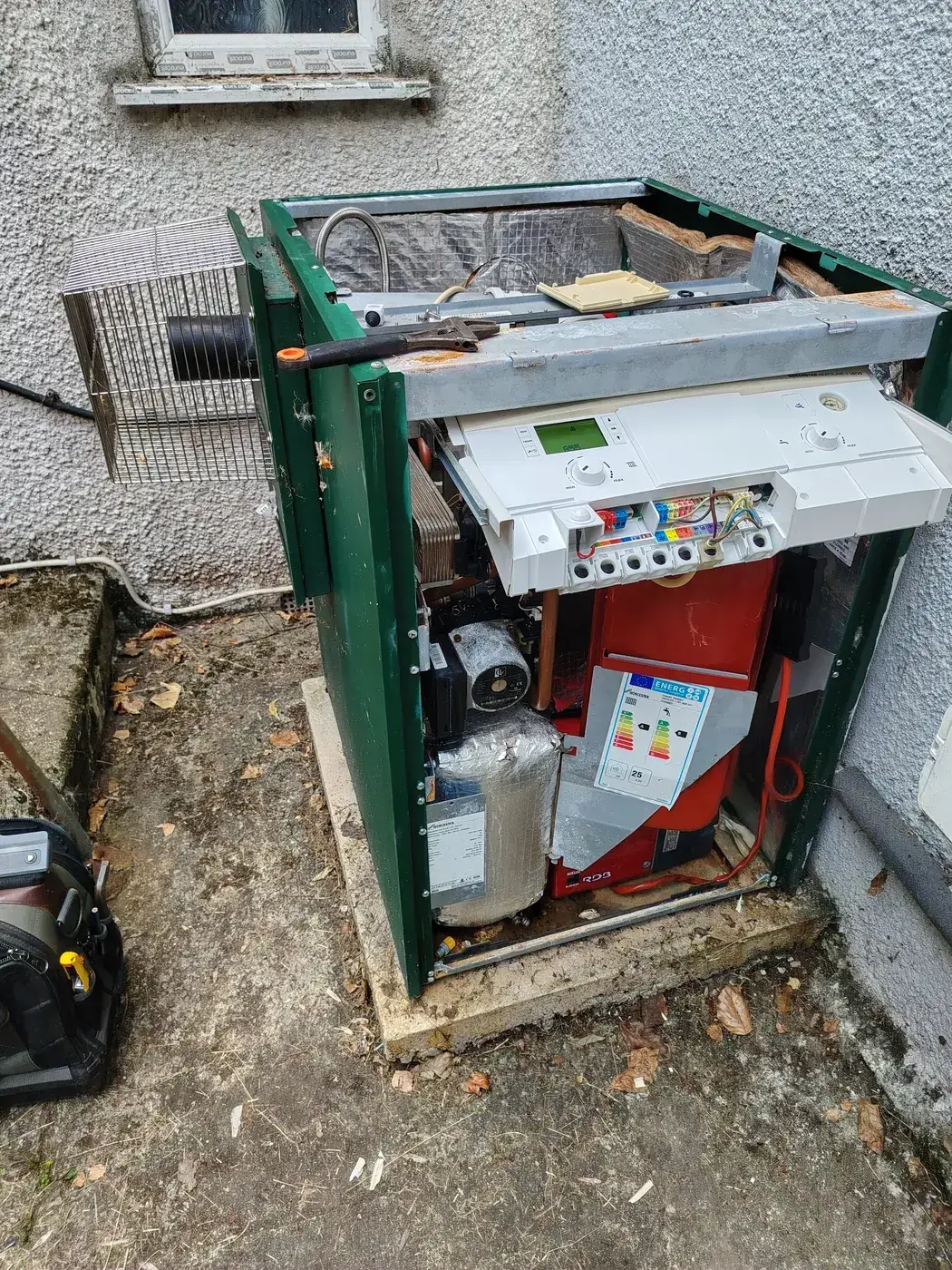
This Worcester Heatslave leak case study covers a real oil boiler leak repair in Exeter: an external Worcester Bosch Heatslave 2 oil boiler serving a customer in Kingsteignton, near Newton Abbot, developed a pinhole leak in the heat exchanger manifold, which caused a complete loss of hot water. Here is how the fault was diagnosed and put right, with photos from the job.
The symptoms: loss of hot water
The customer called because the property had lost its hot water. The boiler is a Worcester Bosch Heatslave 2, an external oil-fired unit housed in the familiar green weatherproof casing outside the house. On this type of boiler a fault developing inside the casing is easy to miss, because everything is tucked away behind the outer panels and out of sight.
What the customer noticed
- No hot water at the taps
- The boiler cutting out or locking out rather than running normally
- A gradual drop in system pressure that had to be topped up
- Signs of weeping and staining inside the external casing
A slow loss of pressure combined with damp, rust-coloured staining inside the case is a classic sign that water is escaping somewhere it should not be. On a sealed heating system even a tiny weep will, over time, drop the pressure far enough for the boiler to stop firing safely, which is exactly what had happened here.
Diagnosis: finding the pinhole leak
With the boiler isolated and the outer casing removed, the internal components could be inspected properly. The control panel and the red combustion chamber were exposed, and the telltale trail of dried water and light corrosion pointed straight towards the heat exchanger. Working back along that trail is how the source of the leak was located.
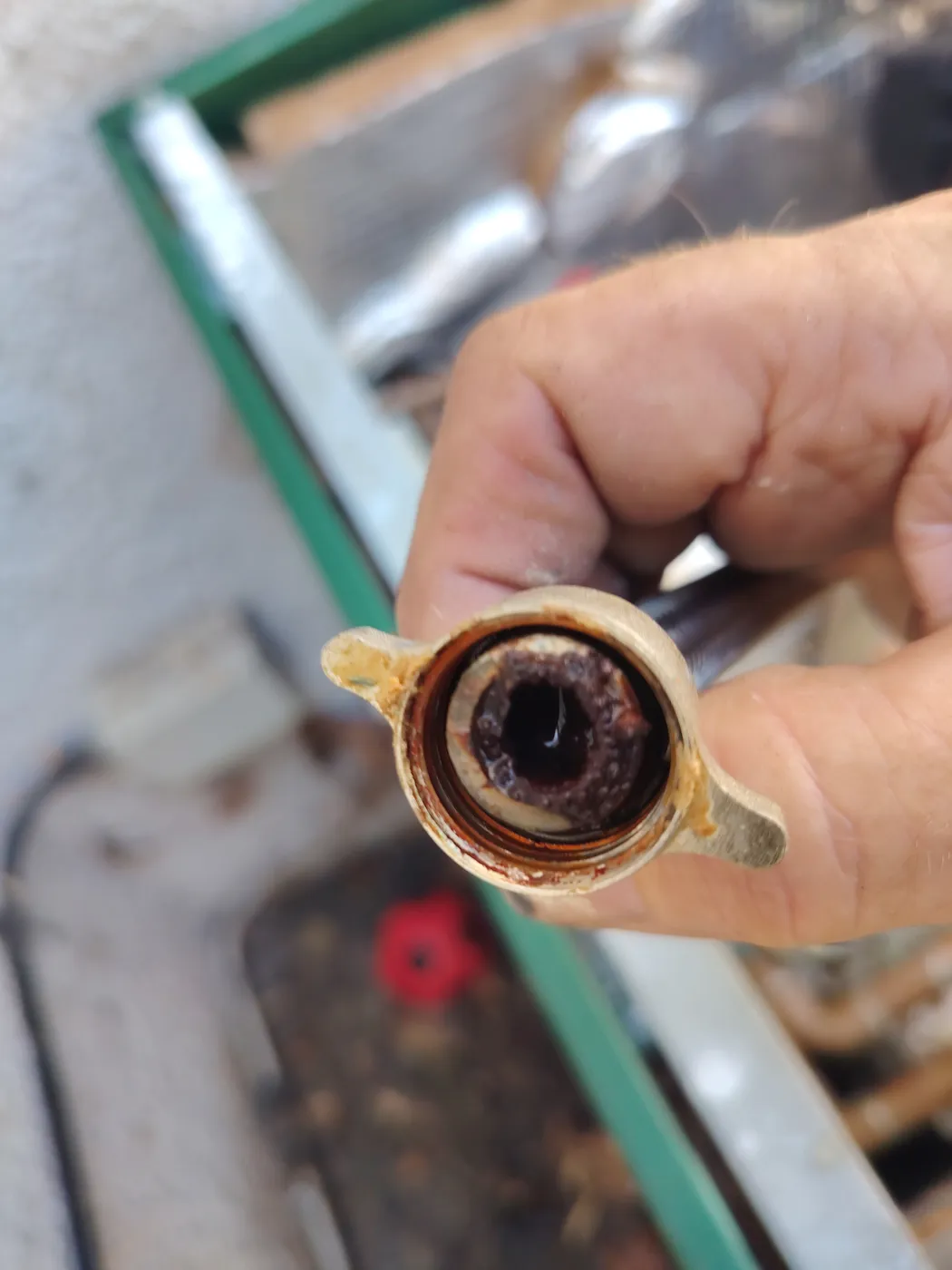
Close inspection of the heat exchanger manifold revealed a pinhole leak – a tiny corrosion perforation in the metalwork that was letting system water escape under pressure. Pinholes like this can be difficult to spot when the boiler is cold and static, so the area was examined carefully with the system pressurised to confirm exactly where the water was coming from.
The repair
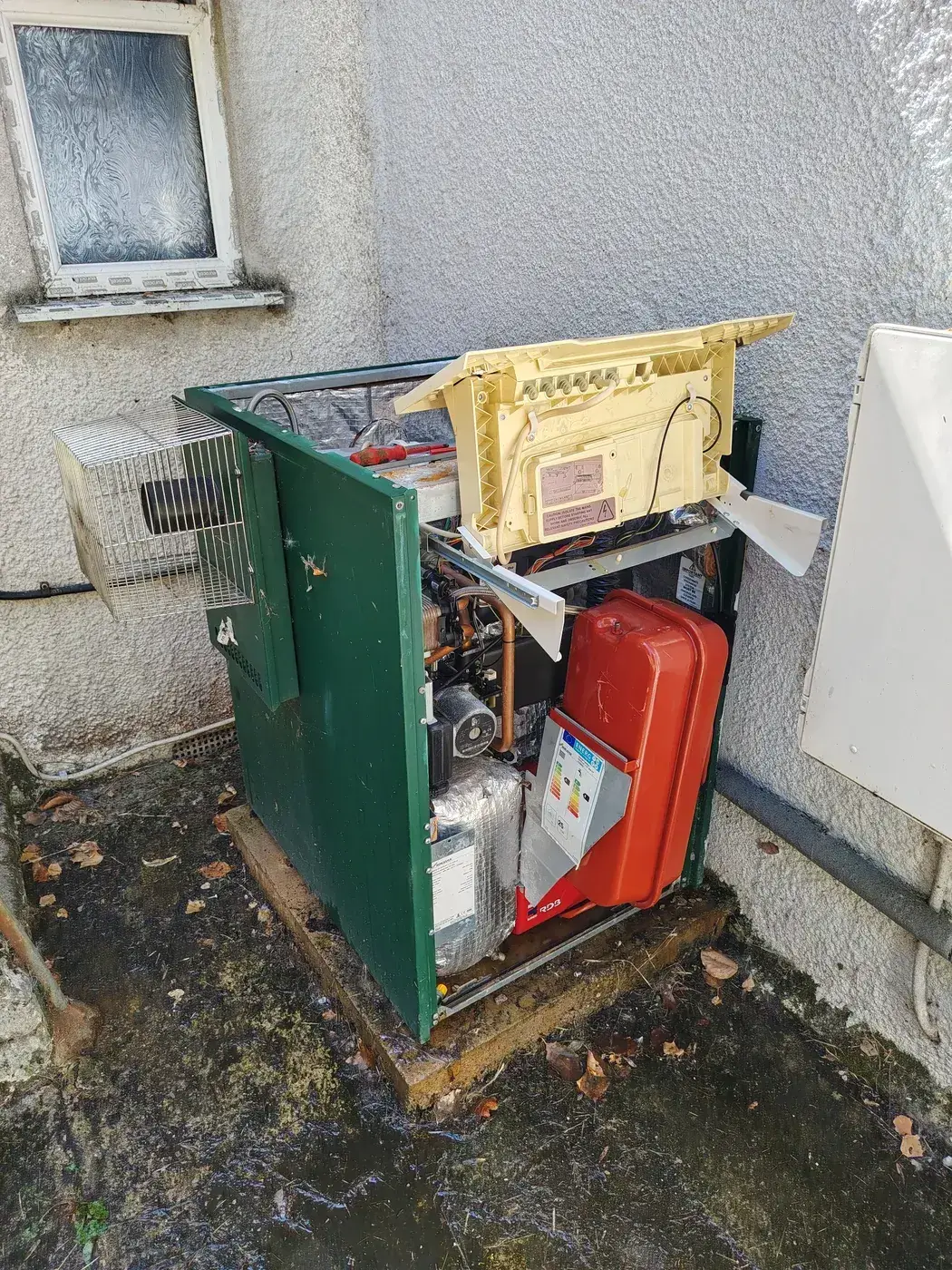
Once the leak was confirmed at the heat exchanger manifold, the boiler was stripped down far enough to reach the affected area safely. That meant removing the outer panels, taking out the components blocking access, and cleaning up the manifold so the fault could be dealt with on sound, clean metal rather than over old corrosion and debris.
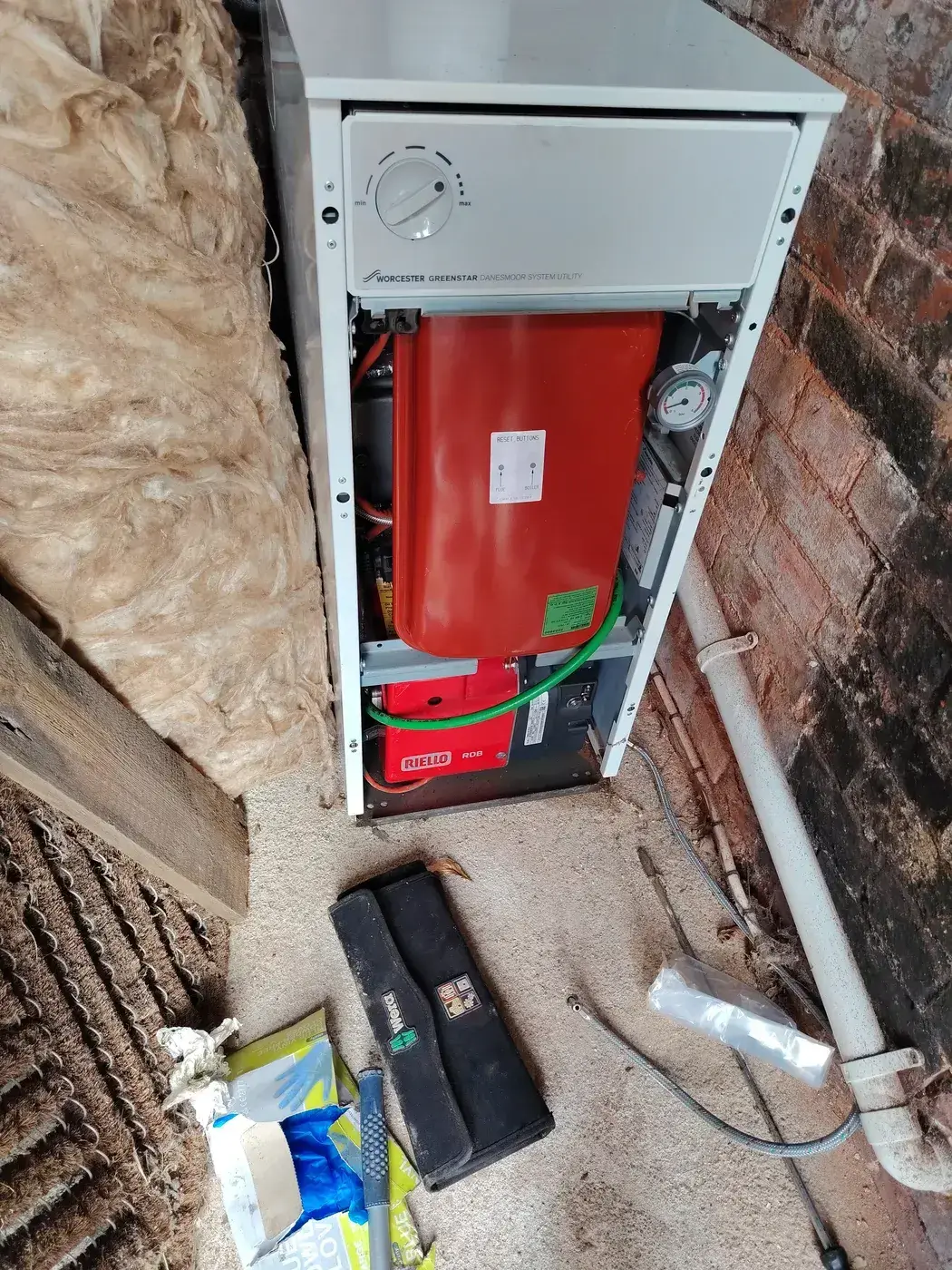
With the manifold accessible and cleaned back, the pinhole was repaired and the joint made good. The heat exchanger area was then checked over for any further weak spots before anything was reassembled – there is no point closing a boiler back up only to find a second leak a fortnight later.
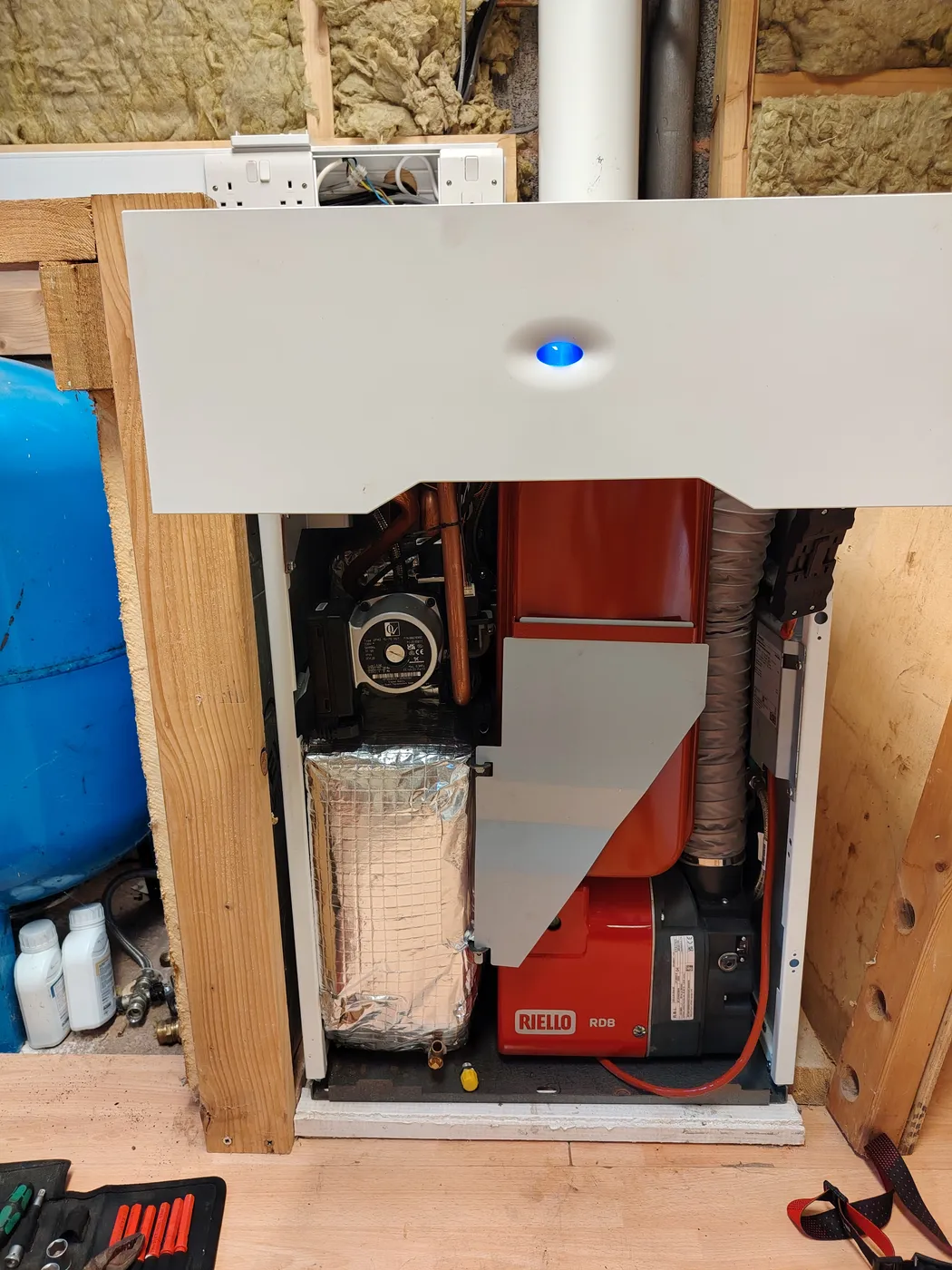
The boiler was then rebuilt, the system refilled and re-pressurised, and the unit fired and run to confirm the leak had stopped, pressure was holding, and hot water was fully restored. The external casing was refitted so the boiler was once again properly protected from the Devon weather.
Why Worcester Heatslave boilers can develop manifold leaks
Worcester Heatslave boilers are well-built, popular oil boilers and they give many years of service, but no heat exchanger lasts forever. There are a few reasons a pinhole leak can appear in the heat exchanger or manifold over time:
Corrosion from the inside
Oxygen and debris in the heating water gradually attack the metal from within. Over years of heating and cooling, thin spots can perforate and produce a pinhole – often long before there is any obvious external damage.
Age and thermal cycling
Every time the boiler fires and cools the metal expands and contracts. On an older boiler this repeated stress, combined with any internal corrosion, is what eventually tips a weak point into a genuine leak.
External exposure
As an external boiler, a Heatslave 2 lives outdoors in its weatherproof casing. Damp, condensation and the Devon climate all encourage corrosion on the outside of components as well as the inside, accelerating wear over the years.
Poor water treatment
A system without the correct inhibitor, or one that has been topped up repeatedly with fresh (oxygenated) water because of an existing leak, corrodes far faster. Keeping the inhibitor level right is one of the best ways to protect a heat exchanger.
The good news is that a single pinhole leak, caught early, does not always mean the boiler needs replacing. Diagnosing it properly and dealing with the actual cause – rather than just endlessly topping up the pressure – can get plenty more life out of a sound boiler.
"We've got no hot water." What Heatslave owners tell me, and what it usually means
Nobody rings to report a pinhole in a heat exchanger manifold. They ring and say one of the things below. The Worcester Heatslave is an oil combi, so it heats your hot water on demand as well as the radiators, and that changes what the symptoms mean compared with a boiler feeding a cylinder.
"We've got no hot water" or "the heating works but the taps run cold"
On a Heatslave the hot water side depends on the boiler being up to pressure and up to temperature, and on a flow switch or sensor seeing water being drawn at a tap. So no hot water with the heating still working usually comes down to one of: system pressure too low for the boiler to fire for hot water, the water store inside the Heatslave not getting hot because the boiler is cutting out early, or a failed flow switch, diverter or sensor. On this job it was the first: the pinhole leak had quietly drained the pressure until the boiler would not run for hot water.
What you can do
- Look at the pressure gauge on the boiler. It should read between 1 and 1.5 bar when cold. If it is near zero, that is your answer.
- Top it up with the filling loop (the short braided hose with one or two small valves near the boiler): boiler off and cold, open slowly, stop at about 1.2 bar, close the valves fully, switch back on.
- Check there is oil in the tank and the boiler switch is on.
- If it comes back and then goes again a few days later, do not keep topping up. You have a leak, and every top-up brings in fresh oxygen that rots the boiler from the inside. Ring me.
"The pressure keeps dropping" or "the needle is on zero again"
A sealed system should hold its pressure for months. If you are topping up every week or two, water is getting out somewhere. On a Heatslave the usual places are a pinhole in the heat exchanger or manifold like this one, a weeping pressure relief valve (look for a drip from the copper pipe through the casing to outside), a radiator valve or joint somewhere in the house, or a flat expansion vessel, which shows up as pressure that climbs into the red when the boiler is hot and drops right back when it cools. A slow leak inside the boiler is the hardest to spot because it often evaporates on the hot metal before it drips. That is why the first job on this one was to pressurise the system and go looking with the casing off.
"There's water under the boiler box outside" or "a damp patch and rust marks"
The Heatslave 2 lives outside in its green weatherproof case, so a leak inside it tends to show as damp or rust-coloured staining at the bottom of the case, a drip from a seam, or a puddle underneath that does not match the weather. Rain finding its way in is possible, but staining with a brown or white crust is system water with inhibitor and corrosion in it, and it means the leak is inside. Do not ignore it because the boiler is still running. This boiler was still running too, right up until the pressure got low enough to stop it.
"The hot water runs hot then cold" or "the shower keeps going cold"
A Heatslave stores a small amount of hot water and then heats the rest on the fly. If the stored water is used and the boiler cannot keep up, you get a burst of hot then lukewarm. Causes range from a tap or shower drawing more than the boiler can heat, to limescale on the hot water heat exchanger, a burner under-firing because the nozzle is worn or the pump pressure has drifted, or low system pressure making the boiler cycle. This one is diagnosed by watching the boiler run while a tap is open, and is often sorted at a service.
"It keeps cutting out" or "it fires up then stops"
If the burner fires for a few seconds and stops with a red light on, that is a lockout: the burner did not see a flame. No oil, air in the oil line, a worn nozzle, a dirty photocell or a blocked condensate drain are the usual suspects. If it fires, runs for a minute or two, stops without a red light and starts again shortly after, it is cycling on a thermostat, which on a Heatslave often means the water is not moving: low pressure, a stuck pump or a sludged system. Press the red reset button once if there is one lit. If it locks out again, stop and ring me; repeated resets dump unburnt oil into the combustion chamber.
"It smells funny", "there's black smoke" or "I can smell oil"
Black smoke or soot around the flue terminal and a hot acrid smell mean the oil is not burning cleanly: a tired nozzle, air setting out, baffles choked with soot or a door seal letting flue gas out. A smell of kerosene means oil is getting out: a perished flexible oil line, a weeping pump or filter joint, or the tank and fire valve outside. In either case switch the boiler off at the switch and ring me rather than pressing reset. If you have an oil boiler and no carbon monoxide alarm, buy one today.
Most of these are caught before they become a cold-shower morning by an annual oil boiler service, which on a Heatslave includes a pressure and leak check as well as the burner work. The full service is £170 including the nozzle and a new long-life oil line.
Worcester Heatslave questions
Why has my Worcester Heatslave got no hot water but the heating works?
Check the pressure gauge first. Below about 1 bar a Heatslave will often still run the heating but not fire for hot water. Top it up to 1.2 bar with the filling loop. If the pressure keeps falling, there is a leak, and inside the casing is the first place to look.
Why does my oil boiler keep losing pressure?
Water is escaping somewhere: a pinhole in the heat exchanger or manifold, a weeping pressure relief valve, a radiator joint, or a flat expansion vessel. Topping up repeatedly hides the problem and corrodes the boiler faster. Get the leak found and fixed.
Can a leaking Worcester Heatslave heat exchanger be repaired?
Sometimes, as on this job, where a single pinhole in the manifold was repaired on clean sound metal and the boiler went on running. A heat exchanger that is corroded through in several places, or a very old boiler, is usually better replaced. I will tell you honestly which it is.
Is a damp patch under my outside oil boiler serious?
Yes if it is there in dry weather or has brown or white staining with it. That is system water, which means a leak inside the casing. The boiler may still run for a while, but the pressure will eventually drop far enough to stop it, usually on a cold morning.
About the engineer
I am David, the owner of Absolute Plumbing & Heating, a one-man business based in Stoke Canon, ten to fifteen minutes north of Exeter, trading since 2010. I did this repair myself. I am OFTEC trained with over ten years' oil boiler experience, and was trained by Grant UK. My OFTEC registration has lapsed, so I do not currently hold OFTEC registration for oil work; I am open about that and the work is done to the manufacturer's instructions regardless.
Gas work is carried out and signed off by P Harman, a Gas Safe registered engineer I work alongside. If you would like an honest assessment of an oil or gas boiler fault, I am happy to take a look.
Worried about your oil boiler?
Losing hot water, a boiler that keeps needing topping up, or damp and staining around an external oil boiler are all worth getting checked before a small pinhole turns into a bigger problem. If you have a Worcester Heatslave or any other oil boiler playing up in the Exeter area, get in touch.
Call for an oil boiler leak repair in Exeter
Speak to an experienced local engineer about your Worcester Heatslave or oil boiler fault.
Call 07766 501664Learn more about our oil boiler services in Exeter.